
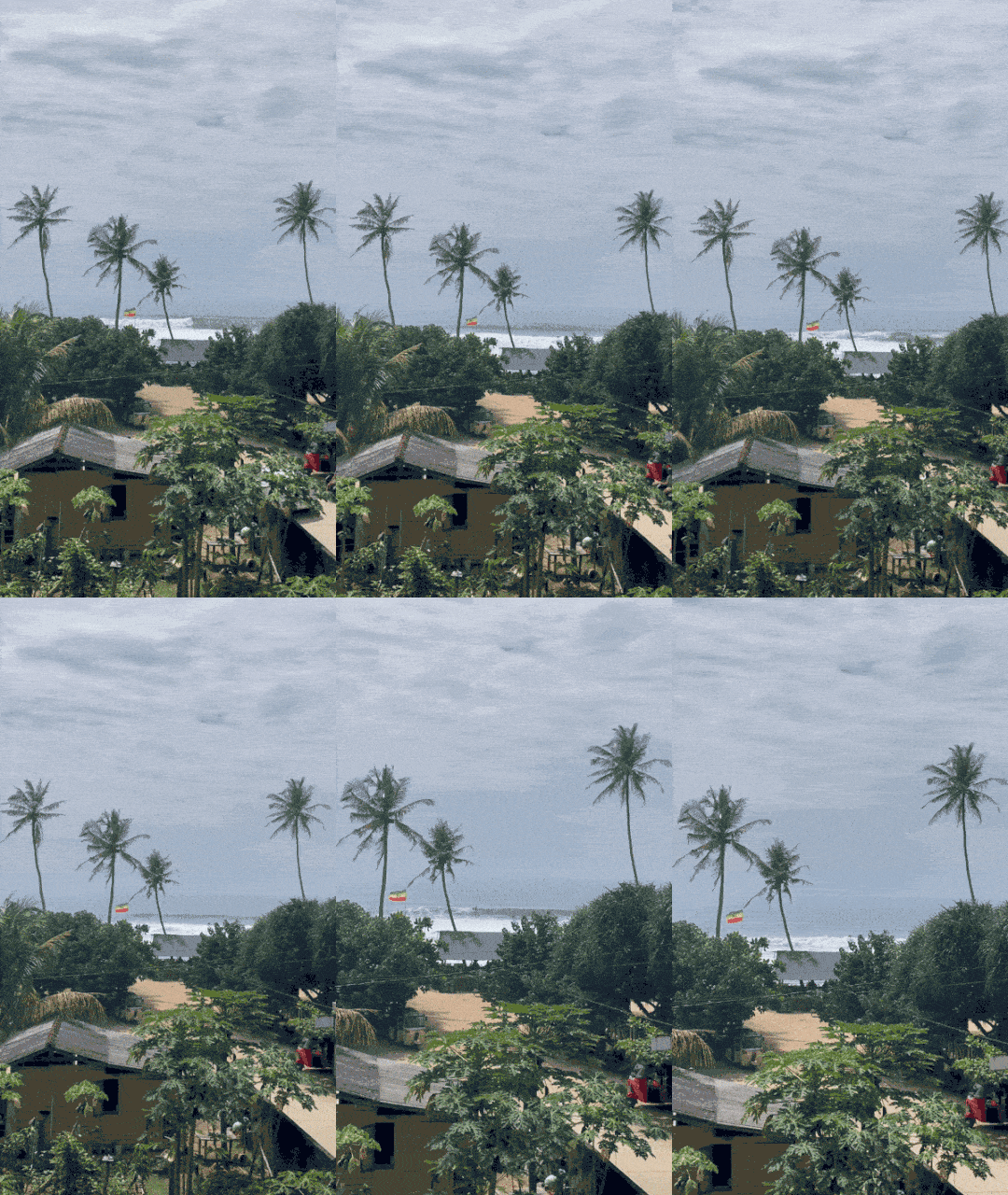
12-2024 – 03-2025 : Midigama and Gurubebila – two villages on the South Coast of Sri Lanka. Known for tropic temperatures, mellow surf, great food and people.
I never really planned to come here. But after the sudden loss of my dog Susi, I needed to change my original travel route Grief follows you wherever you go, but trading a rainy Portuguese winter and an empty-feeling motorhome for three months of living in the jungle, surfing almost every day in warm waters, and being surrounded by chaotic traffic, good food, and warm people became the kind of healing space I needed.
And even though I only stayed in these two villages for the whole 3 months, there was so much to discover.
MIDIGAMA &
GURUBEBILA
Sri Lanka

A1 A VANISHING TRADITION FISING TRADITION
A1 PEACOCKS AS A WEATHER FORECAST
B1–C4 MERMAIDS
B1–D2 MIDIGAMA & GURUBEBILA
D1 THE OLD TEMPLE
E1–E2 LAZY RIGHT & LAZY LEFT
E3–E5 JUNGLE BEACH
E3–E5 TRABONE ISLAND
E3–E5 WELIGAMA
E3–E5 TRABONE ISLAND
E3–E5 ELEPHANT EARS
E3–E5 INDIAN OCEAN
E3–E5 STATUE
E3–E5 LOTUS
E3–E5 LAND MONITOR
E3–E5 SNAKE
E3–E5 TRAFFIC
E3–E5 BUDDHISM
E3–E5 BREAD TRUCKS
E3–E5 CROCODILES
E3–E5 BUDDHISM
A1

Uncle Jack on a post stamp.

The reason Sri Lanka is home to millions of JACKFRUIT trees goes back to the brilliant vision of one man and the year 1915:
As a member of Sri Lanka’s independence movement Arthur V Dias had been sentenced to death by the British. But when freed, he dedicated his life not only to the fight against colonial rule but also to securing the island’s future – by launching a mission to plant 1.000.000 jackfruit trees to fight future food shortages.
Known as Kos Mama (Uncle Jack), Dias distributed seeds across the island, creating backyard food security that still feeds families these days but also through WWII, the 1970s droughts, and even the 2020 pandemic.
Today, Dias is still a national hero — and cutting down a jackfruit tree is illegal, even if it grows on your own land.
SOURCES
https://vidanewspaper.com/2020/10/17/remembering-sri-lankas-beloved-uncle-jak/https://www.bbc.com/travel/article/20200916-jackfruit-the-vegan-sensation-that-saved-sri-lanka
Pictures: Wikicommons

Vintage poster for the Festas de Sao Joao with drawings of Wild Leek.
A1
STILT FISHING began along the southern coast, mainly between Galle and Weligama.
Originally, it was a practical and affordable alternative to fishing from a boat. Fishermen would sit on bamboo poles anchored between rocks or coral reefs, casting their lines – just beyond the breaking waves, several meters out to sea at dusk and dawn.
But in 2004, a tsunami destroyed most of the reef in the southern part of Sri Lanka. With the loss of the reef the fish's dissappeared and many fishermen lost not only their way of making an income, but also their homes and access to the sea.
As a result, stilt fishing largely disappeared and most former stilt fishermen have turned to other professions. A small number continue the tradition. I read only online mainly for visitors — demonstrating the technique rather than relying on it for survival. While often seen as a performance, it also serves as a way to preserve and pass on a fading craft.
It took me some time to witness stilt fishing done for fishing rather than for photographs.
But if you visit the stilts opposite the café Rockvin, between Gurubebila and Midigama, or take a left on Coconut Beach and walk along the beaches on that side – you may get lucky as well.
SOURCES
https://www.picturetheworld.co/post/stilt-fisherman-sri-lanka
https://imkiran.com/the-stilt-fisherman-of-sri-lanka/
Picture
Mstyslav Chernov, Stick fishermen of
Sri Lanka, 2011. Licensed under CC BY-SA 3.0.
Video
private

C1–C2


Just outside Weligama stands a mysterious rock carving that has puzzled historians for centuries. The 7-m-high figure is carved directly into a granite boulder and is believed to be over 1,000 years old. Its exact origins are unknown, but there are many theories and local stories about who it represents.
Archaeologists believe the statue depicts a person destined to reach nirvana. The crown is decorated with tiny seated Buddha figures, and the figure holds a lotus — details that suggest it is Avalokiteshvara (slide 3–5), considered one of the most powerful healers.
But local legend tells a different story > the statue is said to show a king who suffered from leprosy, came here seeking healing, and was eventually cured — giving the site its name, Kushta-raja-gala, or “the rock of the leprosy king.”
Regardless of its origins, Kushtarajagala is the only preserved rock carving of its kind in the area, and locals still visit to pray for relief from illness.
SOURCES
-
Atlas Obscura – Kushtarajagala Statue
https://www.atlasobscura.com/places/kushtarajagala-statue -
LankaPradeepa – Kushtarajagala Bodhisattva Statue
https://www.lankapradeepa.com/2019/05/kustarajagala.html -
Academic references cited in historical research:
-
-
H. A. P. Abeyawardana – Heritage of Ruhuna (2004)
-
C. W. Nicholas – Historical Topography of Ancient and Medieval Ceylon (1963)
-
I. Wikramaratne – Pauranika Sthana Saha Smaraka: Matara Distrikkaya (2015)
-
-––
Photo credit: “Nivaranavishkambhin (Bodhisattva),” painting, Himalayan Art, Creative Commons Zero (Public Domain Dedication)
A1
_(14750608015).jpg)
Sensitive to shifts in air pressure, humidity, and wind, peafowl (Pavo cristatus) often announce approaching rain with sudden, piercing calls — earning them a reputation as natural weather forecasters. This goes for male and female, but the cries of the PEACOCK carry much farther than those of the peahen.
At dusk, despite their size, peafowl fly into tall trees to roost for the night, safely beyond the reach of ground predators.
Nesting, however, happens on the ground: peahens lay and incubate their eggs in shallow scrapes concealed in tall grass, shrubs, or dense undergrowth.
SOURCES
https://animaldiversity.org/accounts/Pavo_cristatus
https://www.southfloridawildlifecenter.org/wp-content/uploads/2018/09/Indian-Peafowl-2018-SFWC.pdf
https://indianbirds.in/pdfs/IB7.5_Rajeshkumar_Balasubramanian_IndianPeafowl.pdf
Note: While specific scientific sources about peafowl calling more before rain are not readily available online, local birdwatching (e.g., calls increasing before storms) are widely reported anecdotally among the locals and in literature.
Illustration
R. B. Sharpe, Indian Sporting Birds, 1915. Public domain.
A1
The surf season in Midigama and nearby Gurubebila goes roughly from November to April, when the southwest monsoon brings consistent swells and warm waters = no wet suit needed.
From my experience: Waves are generally cleaner in the mornings, while winds pick up in the afternoon. It also always gets better after a rain and the surf is almost always crowded but I still always enjoyed it.
There are small reef sharks and further offshore tiger and bull sharks but encounters are close to non existent. I never heard of any stories and the other good news > you'll see turtles in the water. Pretty much every day.
Both villages have their own charm while they are consistently changing. In Gurubebila I really like to take a swim in the natural pool, meet up with friends to watch the sunset at Coconut Point or take a walk from there along the beaches to the east and see what kind of shells I could find.
There is a nice way though the back roads that connect the two villages. I loved riding my bike along the rice fields to spot water buffallo, pea fowls and tons of other birds in the wild.
Last but not least there is a little Veggie Market with local produce each Saturday from x -x that you get more exotic ingredients like bitter gourd, banana flowers, etc.
SOURCES
Conversations with the locals and my own experiences.

A1
When I first saw the two mermaids painted on a house in the jungle of Midigama, I instantly knew they would become the main characters of my map. To me, the two villages feel like sisters—closely connected, yet each with its own distinct character.
What I love about Gurubebila is its everyday rhythm: small cafés, street vendors, and the way the village opens up toward the sea. Sunset at Coconut Beach is a favorite ritual, followed by a walk east along the coastline, a swim in the natural pool, or a visit to the local second-hand shop.
Midigama is a wonderful place for people-watching and spending long hours on the beach. One of my favorite spots is the Chillout, a sweet café tucked along the river. On Saturdays, a lively market offers local produce such as banana blossoms, long beans, bitter gourd, ash pumpkin, fresh fish, and whatever else is in season.
Both villages are constantly changing while holding onto their own charm. A quiet back-road route connects them, winding through rice fields where I loved cycling and spotting water buffalo, peafowl, and many other birds in the wild.

A1
Along my daily walk to the surf in Midigama, I passed a small temple marked by three symbols: sun, moon, and wheel. I noticed them on other temples as well and learned that each has a specific meaning in Sri Lankan Buddhism:
-
Sun (Suriya): continuity, life force, and awareness of the visible, active world
-
Moon (Chandra): change, cycles, and the quieter, reflective side of existence
-
Wheel (Dharma Chakra): the path, moral order, and the teachings of the Buddha
Together, these symbols express that the Dharma—Buddhism as a guide for life—remains valid at all times, day and night, waxing and waning. In Sri Lanka, Buddhism is not just a religion but a way of moving through space and time: ethical, aware, and deeply connected to the land and everyday life.
A1
Along my daily walk to the surf in Midigama, I passed a small temple marked by three symbols: sun, moon, and wheel. I noticed them on other temples as well and learned that each has a specific meaning in Sri Lankan Buddhism:
-
Sun (Suriya): continuity, life force, and awareness of the visible, active world
-
Moon (Chandra): change, cycles, and the quieter, reflective side of existence
-
Wheel (Dharma Chakra): the path, moral order, and the teachings of the Buddha
Together, these symbols express that the Dharma—Buddhism as a guide for life—remains valid at all times, day and night, waxing and waning. In Sri Lanka, Buddhism is not just a religion but a way of moving through space and time: ethical, aware, and deeply connected to the land and everyday life.
